The 3-Step Piles Relief Protocol

A MUST WATCH VIDEO FOR ANY ONE SUFFERING FROM PILES.


A PRIVATE LETTER TO ANYONE TIRED OF THIS CYCLE

The Toilet Visit You Dread Every Morning — And Why It Keeps Coming Back

You wake up and the first thought isn't about your day. It's about your stomach. Whether today will be one of the easy days, or one of the days you dread.

You sit there longer than you should, straining a little more than you know you should, hoping today it won't hurt.

Sometimes it's fine. Other times, it isn't — and you spend the rest of the morning trying to sit normally at your desk, in traffic, in a meeting, without anyone noticing.

You've told yourself it will pass. But it keeps coming back, a few days apart, like it's just... your body now.

You're not alone in this, and you're not being dramatic. This is a real, common, physical problem — and there's a reason it keeps repeating itself.

Written by someone who lived this for years before understanding why.
``` \
\

Here's What Nobody Told You

Most people treat pile discomfort as the problem itself. It isn't. It's usually the result of something else happening upstream — something quieter, that repeats every single day without you noticing.

Hard, difficult-to-pass stool is often the real engine behind the cycle. When stool is hard, your body has to work harder to move it — and that extra effort is straining. Straining puts direct pressure on the exact tissue that's already irritated.

So the pattern looks like this: not enough fibre and fluids most days → stool becomes harder → the toilet becomes a struggle → straining increases → the irritation gets provoked again → and just as it starts to settle, the same habits bring it right back.

This is why creams and spot-treatments alone can feel like they "stop working" — they're addressing the irritation, but nothing is addressing the straining that keeps re-triggering it. It's not that those products are useless. It's that they're only treating one half of a two-part problem.

Once you see the cycle for what it is, the way forward becomes obvious: support easier, softer bowel movements, reduce the specific habits that cause straining, and give the area a genuine chance to settle — consistently, not just on the days it hurts.

That's the entire logic behind the protocol you're about to read about. Nothing exotic. Just breaking the cycle at its actual source.

My Own Story — Written in My Own Words

I'm going to tell you something I didn't tell my wife for almost eight months. I didn't tell my business partner either, and God knows I saw him nearly every day at our shop on Allen Avenue.

I had piles. Bad ones. And for the longest time, I was too embarrassed to say the word out loud, even to myself.

How It Started

It began, if I'm honest, with nothing dramatic. I was in my late 40s, running two small businesses in Lagos, sleeping too little, eating whatever was fastest — a lot of bread, a lot of rice, not enough water, and definitely not enough vegetables. I told myself I'd "sort my diet out" once things calmed down at work. Things never calmed down.

Constipation crept in first. I didn't think much of it — I assumed everybody struggled sometimes. But it kept happening, two or three times a week, and each time I strained more than I should have, just to get it over with and get back to my desk.

Then one Tuesday morning, there was blood. Not a lot, but enough to make my hands shake a little as I stood in my own bathroom in Ikeja, staring at the tissue, trying to convince myself it was nothing.

"I remember thinking — I've built companies, negotiated contracts, raised children. And I'm standing here terrified of my own toilet."

What It Cost Me

I want to be honest about this part, because I think it's the part people skip when they tell these stories.

It cost me sleep — I'd lie awake dreading the next morning. It cost me focus at work; I'd catch myself shifting in my chair during meetings, unable to sit comfortably, pretending everything was fine. It cost me closeness with my wife, Folake, because I was distracted and short-tempered, and I never told her why. She thought it was business stress. I let her believe that, because the alternative felt too humiliating to say out loud.

I even started avoiding public toilets altogether — turning down invitations, cutting meetings short, planning my whole day around being near my own bathroom. Looking back now, I can see how much smaller my life had become without me even noticing it happening.

Everything I Tried That Didn't Work

I want to list these honestly, because I tried a lot before I understood anything.

1. Over-the-counter creams. I bought three different ones from a pharmacy near Computer Village. They gave temporary numbness, some relief for a few hours, but the underlying problem — the straining, the hard stool — was untouched. A few days later, back to square one.

2. A herbal concoction from a roadside seller in Ibadan. A friend swore by it. I drank it for two weeks. It did something to my stomach, certainly — mostly discomfort — but nothing that addressed what was actually happening.

3. Ignoring it completely. For about three months, I simply told myself it would go away on its own if I "didn't think about it." It didn't go away. It got worse, and the bleeding became slightly more frequent.

4. Random YouTube advice. I tried a rotating list of "miracle" home remedies I found online — none tailored to what was actually causing my symptoms, no structure, no consistency. I'd do something for two days, get bored or busy, and stop.

5. Avoidance and distraction. I genuinely tried to just "manage around" the problem — softer toilet paper, sitting differently, rushing through meals so I could get home. None of it touched the actual cause.

The Turning Point

The morning I saw blood again — heavier this time — I finally went to see a doctor at a private hospital in Ikeja. I sat in that waiting room more nervous than I'd been in any boardroom in my life.

The doctor examined me, reassured me it was consistent with hemorrhoids aggravated by constipation and straining, and gave me the kind of plain, practical explanation nobody had ever bothered to give me before: fix the stool, and you take most of the pressure off the problem. She also told me clearly — if the bleeding continued or worsened, or anything looked unusual, I needed to come back immediately for proper evaluation. I never forgot that instruction, and I still repeat it to anyone I share this with.

That conversation changed how I thought about the whole thing. I stopped hunting for a magic cream and started paying attention to the actual pattern: what I ate, how much water I drank, how I used the toilet, and how much I was straining without even realizing it.

I began deliberately eating more fibre — vegetables, oats, beans, fruit — and forcing myself to drink water consistently through the day, not just when I remembered. I stopped rushing on the toilet. And almost by accident, I discovered that a warm sitz bath in the evening gave me a level of comfort nothing else had — a simple, quiet fifteen minutes that made a genuine difference to how I felt.

How the Protocol Came to Be

Within a few weeks, I noticed something I hadn't felt in a long time: I wasn't dreading mornings anymore. Not because the problem vanished overnight, but because I finally had a routine — something consistent I was doing every single day instead of just reacting when things got bad.

I started writing it down for myself first — a simple daily checklist taped inside my bathroom cabinet. Then a friend, someone I finally opened up to, asked if I could write it out properly for him. Then another friend. Then a small WhatsApp group of men my age who, it turned out, were quietly dealing with the exact same thing and never talking about it either.

That's the honest, unglamorous origin of this guide. It wasn't built in a lab. It was built in my own bathroom, refined over months of paying close attention, and shaped by every failed attempt that came before it.

I'm not a doctor, and this isn't presented as one. It's a practical, structured routine built from real experience and from what my own doctor confirmed about the role of hard stool and straining — organized so you don't have to stumble through years of trial and error the way I did.
What Changed, Day by Day

This is the timeline I personally noticed once I started following the routine consistently. Everyone's body responds differently, and this isn't a promise of identical results — but it shows what a consistent routine can look like in practice.

Day 1

Starting the routine

Began tracking water intake and fibre-rich meals properly for the first time. No noticeable physical change yet — but for the first time in months, I felt like I was doing something instead of just hoping.

Day 5

Stool became noticeably softer

Bowel movements started requiring less effort. I wasn't gripping the sides of the toilet anymore. The warm sitz bath in the evenings had become a habit I looked forward to.

Day 7

Less straining, less irritation

The morning dread had reduced significantly. Sitting at my desk for long meetings was noticeably more comfortable than it had been in months.

Day 12

A stretch of calm days

Several days in a row with no discomfort at all — the longest stretch I'd had in over a year. I started trusting the routine instead of just hoping it would work.

Day 21

It had become a normal part of my day

The checklist wasn't a chore anymore — fibre, water, toilet habits, the evening sitz bath — it was just how I lived now. That's when I knew this needed to be written down properly for other people.

What Readers Are Saying

Shared with permission from private community posts.

★★★★★
Ibadan · 2 weeks ago
Chai, this guide open my eye well well. I don dey use cream since but the tracker help me see say na my toilet habit dey cause the wahala. Two weeks now, e don reduce well.
★★★★★
Port Harcourt · 5 days ago
The sitz bath tip alone don worth the money for me honestly. I no sabi say small warm water fit calm body like that. I'm sleeping better sef because I'm not so uncomfortable at night again.
★★★★★
Abuja · 3 weeks ago
I don try many many things before I see this one. The 7-day tracker na the thing wey finally make me consistent — before now I go start something today, forget am tomorrow. Now na routine.
★★★★★
Lagos · 1 month ago
The warning-signs checklist actually make me go see doctor when something no just feel right — and the doctor confirm say I do the right thing on time. I appreciate say the guide no just dey tell person na home remedy go fix everything.
★★★★★
Benin City · 9 days ago
As someone wey too shy to even discuss this with doctor, this guide give me language to understand my own body first. The fibre and water part alone don change how I dey eat. Straining don reduce plenty.

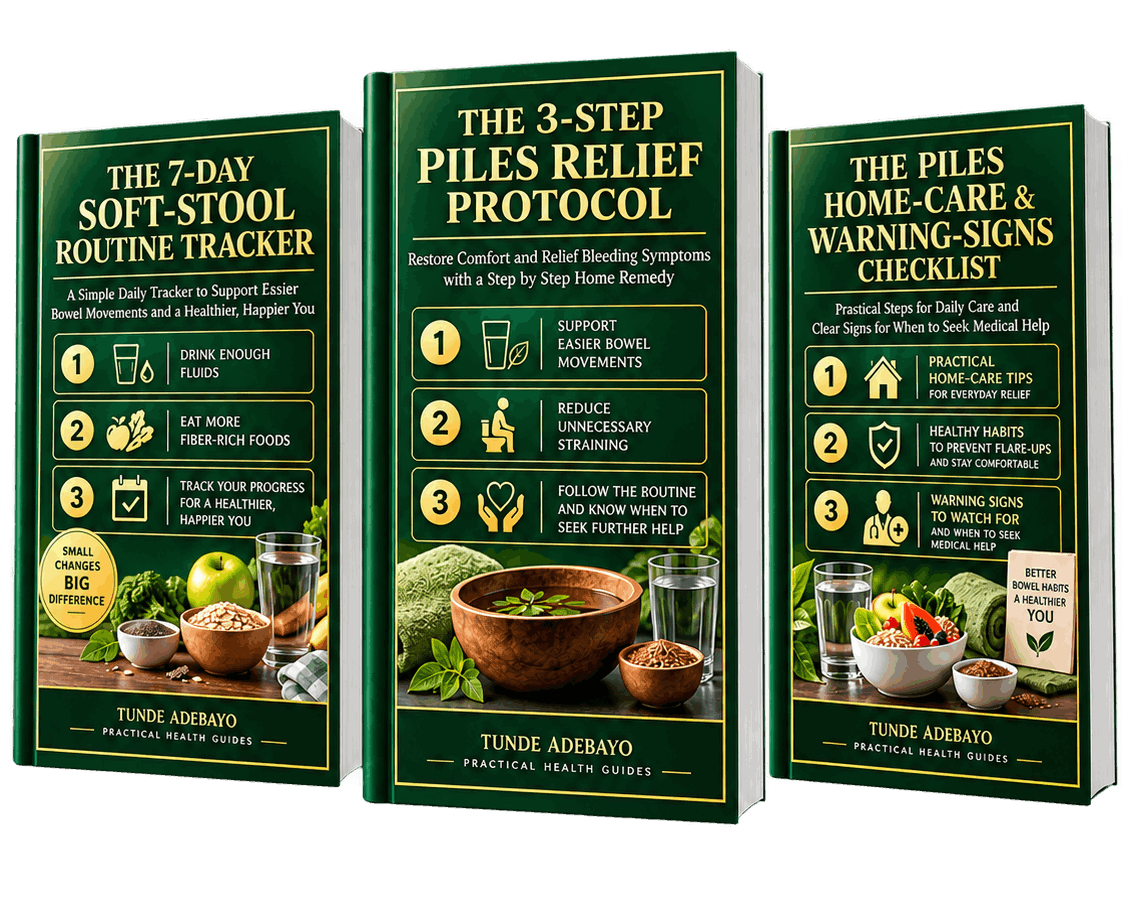
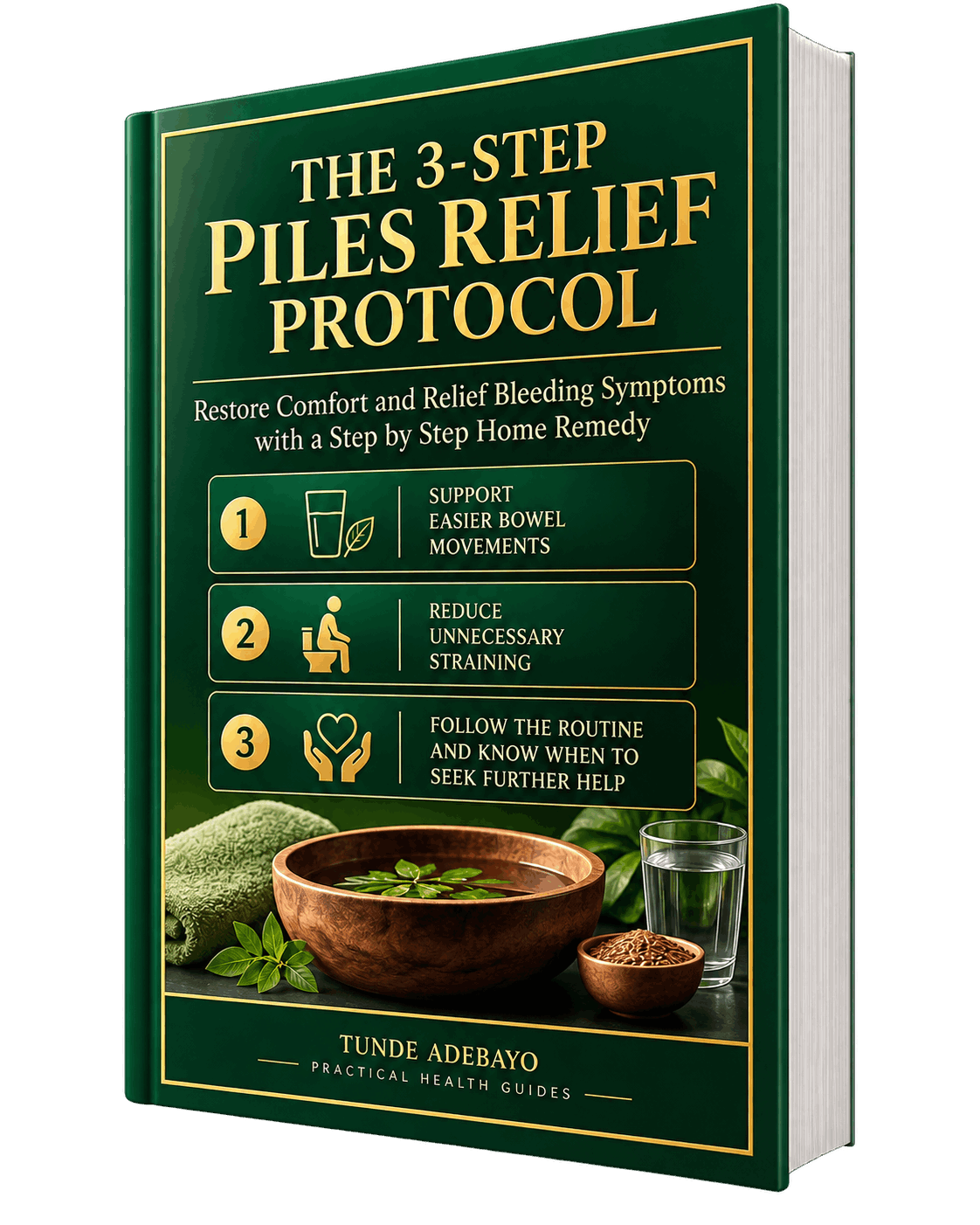
Introducing: The 3-Step Piles Relief Protocol

A structured, page-by-page guide built directly from everything above — organized so you can follow it in order, without guesswork.

Understanding the Cycle: Constipation, Straining & Symptom Flare-UpsPages 4–13
Step 1 — Supporting Easier, Softer Bowel Movements (Food, Fibre & Fluids)Pages 14–24
Step 2 — Reducing Straining & Aggravating Daily HabitsPages 25–33
Step 3 — The Daily Routine, Comfort Measures & the Warm Sitz Bath MethodPages 34–42
When to Seek Professional Medical Evaluation — Warning Signs ExplainedPages 43–47
Putting It All Together: Your Week-by-Week RoutinePages 48–52

Plus, Two Bonuses to Keep You Consistent

BONUS 1

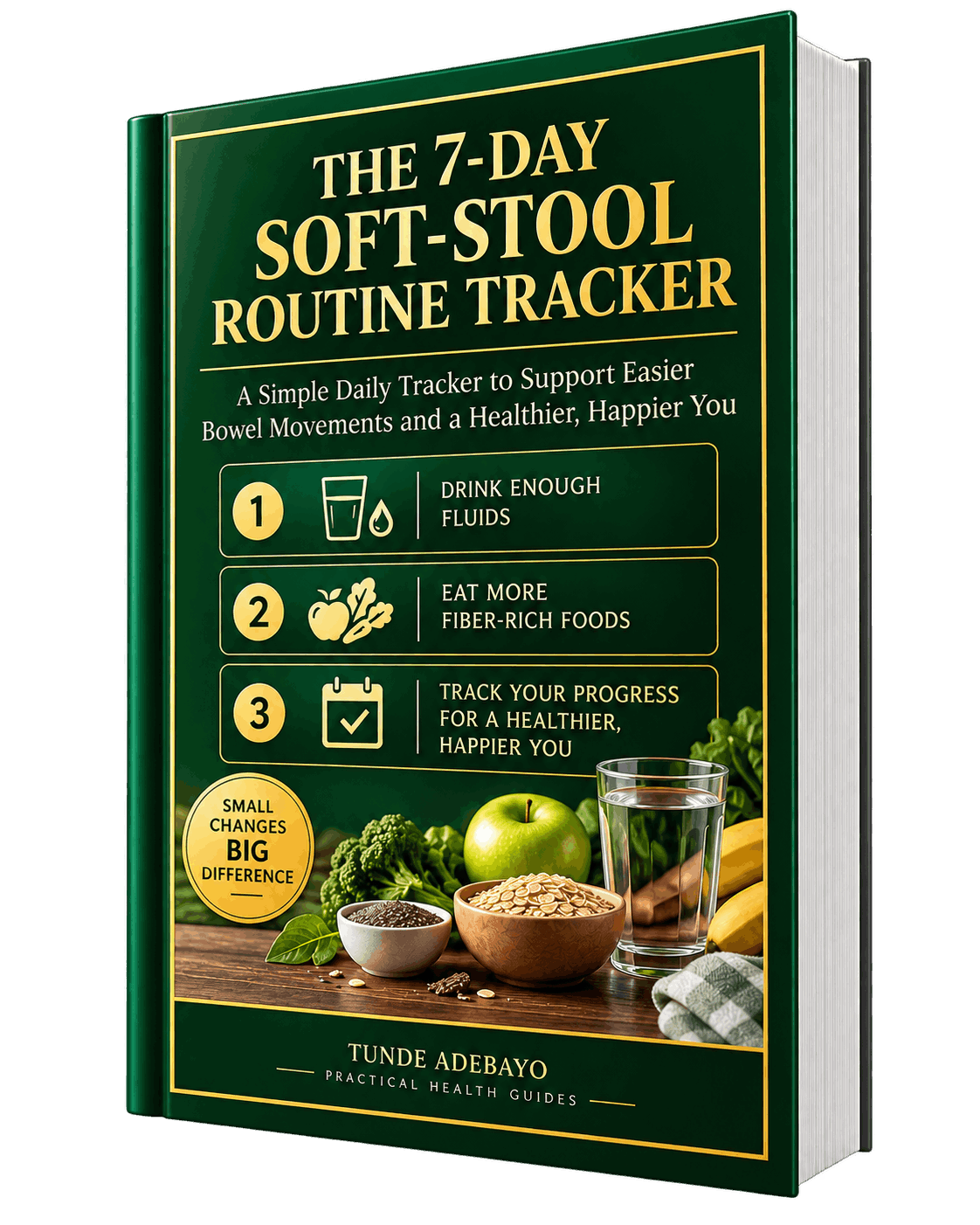
The 7-Day Soft-Stool Routine Tracker

A simple printable sheet where you log your water intake, fibre-rich meals, bowel movements, how difficult each one was, and any straining or symptom changes. This is the tool that turns "I'll try to remember" into an actual habit — because the biggest reason home routines fail isn't the information, it's inconsistency. This tracker fixes that.

Standalone value: ₦3,500
BONUS 2

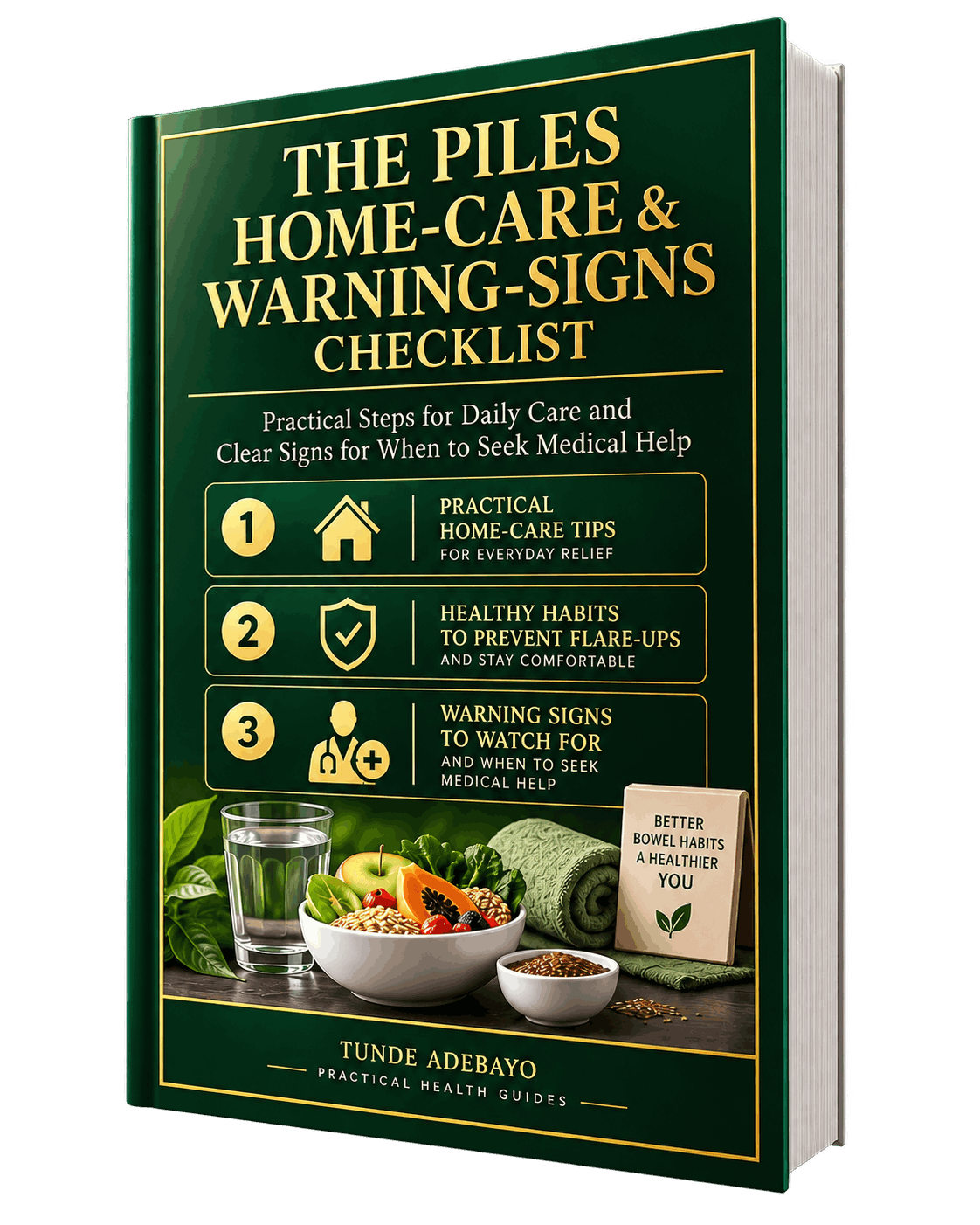
The Piles Home-Care & Warning-Signs Checklist

A quick-reference page you can glance at any day — the home-care habits worth paying attention to, side-by-side with the specific warning signs that mean it's time to stop relying on self-care and get proper medical evaluation. This isn't here to scare you; it's here so you're never guessing about when self-care is enough and when it isn't.

Standalone value: ₦3,200

Today's Complete Offer

The 3-Step Piles Relief Protocol (PDF)₦19,500
Bonus 1 — 7-Day Soft-Stool Tracker₦3,500
Bonus 2 — Home-Care & Warning-Signs Checklist₦3,200
Total Value₦26,200
Your Price Today
₦9,800
₦19,500 — Launch pricing
Get Instant Access — ₦9,800
This launch price is available to the first 50 buyers only. After that, the price returns to ₦19,500.
🔒 Secure Checkout ⚡ Instant Download ✉️ Discreet Billing — no product name on your statement
30

Our 30-Day Satisfaction Guarantee

Read it. Use the trackers. Try the routine for a full 30 days. If you feel the guide genuinely wasn't useful to you, write in and request a refund under our stated terms — no lengthy back-and-forth, no guilt trip.

This is a guarantee on the material itself, not a promise of a specific medical outcome — nobody can honestly promise you that, and we won't pretend otherwise.

Two Ways This Goes From Here

OPTION 1

Close this page

Tomorrow morning looks exactly like today. Same hesitation before the toilet. Same discomfort you're managing quietly, hoping it eases on its own. Three weeks from now, you're likely still guessing — still cycling between "it's fine" and "it's back again," without a routine that actually addresses why.

OPTION 2

Start today

Three weeks from now, you've got a daily rhythm — food, fluids, habits, comfort measures — that you actually understand and trust. You know what's helping. You know the warning signs that would send you to a doctor without panic. Mornings stop being something you brace for.

P.S. — You have 30 full days to go through everything and decide if it's right for you. If it isn't, you can request a refund under our stated terms. There's no real risk in simply reading it.

P.P.S. — The ₦9,800 launch price is only for the first 50 buyers. Once that's reached, it returns to ₦19,500. This isn't a countdown gimmick — once the 50 spots are gone, they're gone.

P.P.P.S. — I wrote this because I remember exactly what it felt like to sit alone with this problem, too embarrassed to say the word out loud. If even one part of my story sounded like your mornings, you don't have to keep guessing your way through this the way I did.

This guide is educational and intended for general home-care support. It does not diagnose, treat, or cure any medical condition, and it is not a substitute for professional medical advice. If you experience persistent, severe, recurrent, or unexplained symptoms — including ongoing bleeding — please consult a qualified healthcare provider.